Skip links

The Construction Sector Report 2023

This report aims to provide detailed insights into the South African Construction sector. The JSE lists 17 companies in the Construction & Materials sector. There are four construction companies included in this report. This sample constitutes 24% of the JSE listed companies in this sector.

WBHO is one of the largest construction companies in South Africa. During Covid-19 lockdown period, many construction workers were laid off due to the cessation of building activities. WBHO managed
to retain their staff while surviving this period financially.

During its budget presentation in February 2022, the South African government announced that it would be allocating over ZAR 800 billion to public sector infrastructure projects. In 2020, some reports had the sector employing over 1,3 million people.1 The construction sector plays a vital role in job creation and broader economic development in South Africa, making this an important sector for the LRS to monitor.

The data extracted from the LRS’s MNC Database enables a retrospective view of company performance over the course of the last ten years. In undertaking this project analysis, we explain the sector in detail, provide a financial overview of the sector, and conclude by examining the directors’ remuneration over the last
twelve years.

Deconstructing South Africa’s construction industry performance

The Sector

The construction sector is crucial in contributing to economic growth.

The construction sector is crucial in contributing to economic growth, infrastructure development and poverty alleviation. The sector provides low-entry jobs as it predominantly employs workers classified as elementary occupation labours.

The construction sector in South Africa is governed by various bargaining councils. A total of 78% of all employees in South Africa are covered by collective bargaining The CIDB states that 70% of the labour force employed in the construction industry consists of semi-skilled and unskilled2 workers.

However, the sector grapples with persistent challenges. These include illegal work stoppages due to community protests and disruptions by vigilante groups. A recent menace to the industry is the emergence of the so-called “Construction mafia.” These groups forcibly occupy construction sites nationwide, demanding up to 30% of a job’s contract value. It has been reported that since 2019, 183 projects with a combined worth of ZAR 63 billion have been hit by extortion3. Addressing the issue, the Minister of Public Works, Sihle Zikalala, indicated that more than 700 people have been arrested.

The Construction Sector continues to be a priority for the economic development of the country. The National Infrastructure Plan (NIP), an integral part of the government’s Economic Reconstruction and Recovery Plan, aims to generate over 800,000 jobs and attract more than ZAR 1 billion in infrastructure investments in the next four years5. Conceived as a long-term strategy, the NIP underscores the importance of infrastructure development. As the plan unfolds, this sector is poised to play a pivotal role in job creation, benefiting both formal and informal
workers.

Financials

Revenue

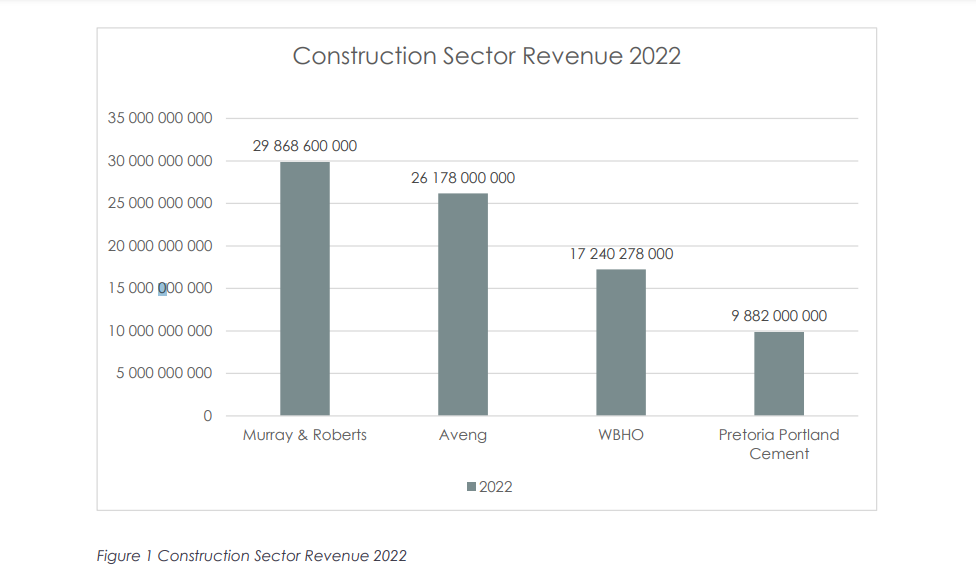
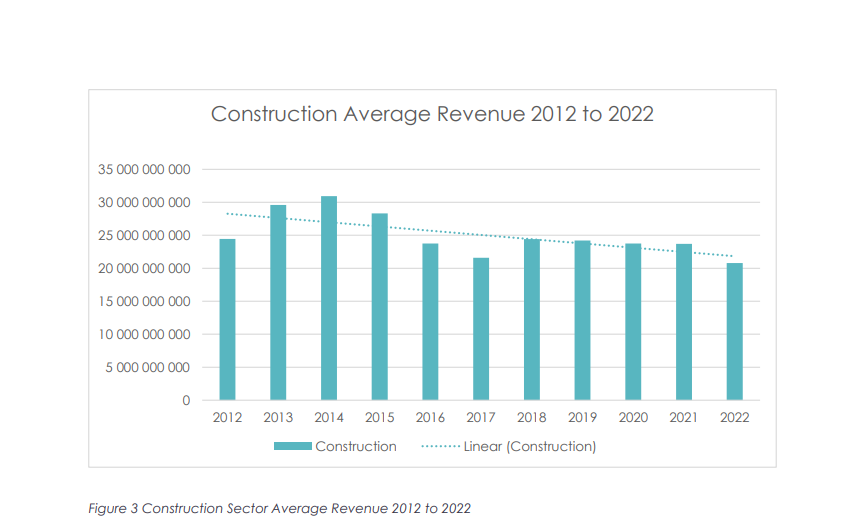
In 2022, the companies reported an average revenue decline of 1.54%, compared to a smaller decline of 0.2% in 2021. However, the average revenue remains below the pre-pandemic levels.

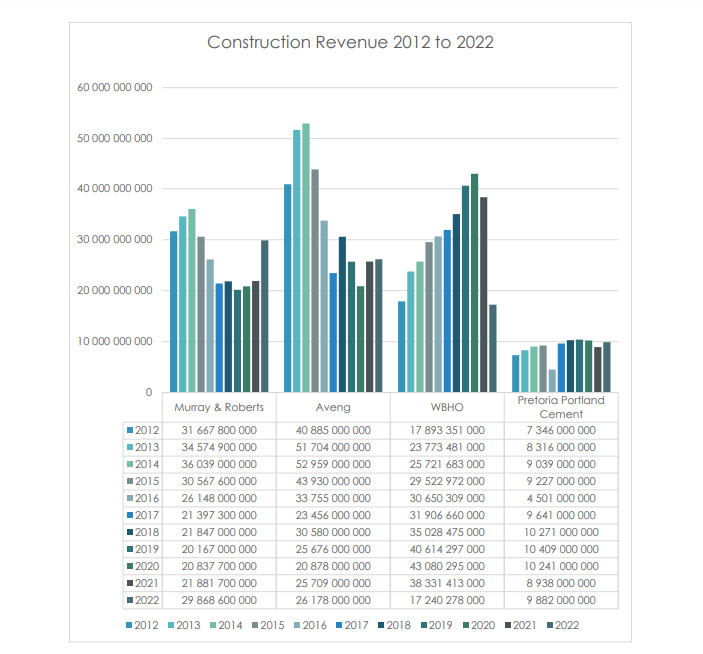
In 2022, WBHO reported a decline in revenue by 55.02%, following an 11% decrease in 2021. Meanwhile, Aveng, Pretoria Portland Cement, and Murray & Roberts saw their revenues increase by 1.82%, 10.56%, and 36.50%, respectively.

Both Murray & Roberts and Aveng have consistently posted revenue growth from 2020 to 2022. On the other hand, WBHO experienced a decline in revenue throughout this period. Pretoria Portland Cement faced a revenue drop from 2020 to 2021 but reported a modest increase from 2021 to 2022.

In the 2022 financial year, WBHO discontinued its operations in Australia, incurring significant financial costs as it grappled with the impacts of reduced activity in both Australia and the UK operations6. The company states that the consistent decline in revenue was attributed to the UK based operations due to low business confidence since Covid-19, uncertainty and the rising costs associated with the war in Ukraine. WBHO’s share price has depreciated compared to its peers over the five-year period.

https://www.news24.com/fin24/companies/wbho-reports-r15bn-loss-plans-to-exit-australian-construction-20220301


Profit before Tax

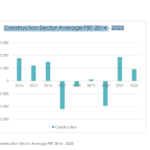
All companies in the sample posted positive figures for Profit Before Tax (PBT) in the 2022financial year. WBHO reported a PBT of ZAR 1 billion, an increase from ZAR 600 million in 2021. Murray & Roberts had a PBT of ZAR 500 million, which, while positive, is still considered underwhelming compared to their average PBT of ZAR 900 million from 2014 to 2019.

Pretoria Portland Cement’s PBT stood at ZAR 180 million, a significant drop from the ZAR 1 billion reported in 2021. Notably, in 2020, they faced their steepest decline in PBT, amounting to ZAR 1 billion. Within the sample period of 2014 to 2022, Aveng posted positive PBT figures of ZAR 60 million in 2016, ZAR 1 billion in 2021, and ZAR 150 million in 2022.
Directors’ Remuneration

CEO Remuneration 2022

The LRS MNC database provides insights into CEO remuneration trends over the past twelve years. In the construction sector, there was minimal deviation between the average total salary and the average total salary inclusive of LTIs from 2011 to 2016.

A slight deviation was observed in 2017. However, post pandemic, there’s been a noticeable upward trend. On average, the CEO remuneration increased by over 38% from 2021 to 2022, a bit lower than the 42% rise observed from 2020 to 2021.

Average CEO Remuneration 2011 to 2022

In our construction sector sample, Aveng’s CEO Flanagan received the highest total remuneration, which comprised a cash bonus of ZAR 6.8 million and an LTI of ZAR 13 million. He was followed by Pretoria Portland Cement‘s CEO van Wijnen, who had the second-highest total package. This included a cash bonus of ZAR 6.1 million and an LTI of ZAR 11 million.

On average, executive director remuneration in this sample increased by 20% from 2021 to 2022. In the same period, the non-executive director average total remuneration increased by 22%.


Average Non-executive director remuneration 2019-21
This website uses cookies to improve your web experience.
Signup
Login
Ufinda
Chat
Explore
Drag